


Uncovering the Layers of Ancient Beth Shan
Beit She’an is an expansive archaeological park at the junction of the Jordan and Jezreel valleys, preserving over 7,000 years of layered history. As you approach the site, the 80-meter-high settlement mound of Tel Beit She’an dominates the landscape. This ancient core contains 20 distinct layers of occupation, revealing its early role as a major Egyptian administrative center and military garrison.
Looking up at the steep walls of the mound, you are standing near the setting of a pivotal biblical event. According to the biblical account, following the Battle of Mount Gilboa, the Philistines fastened the bodies of Israel’s first king, Saul, and his three sons to the fortifications of Beth Shan. The city was later incorporated into the Israelite kingdom under King David, cementing its place in Jewish historical memory.
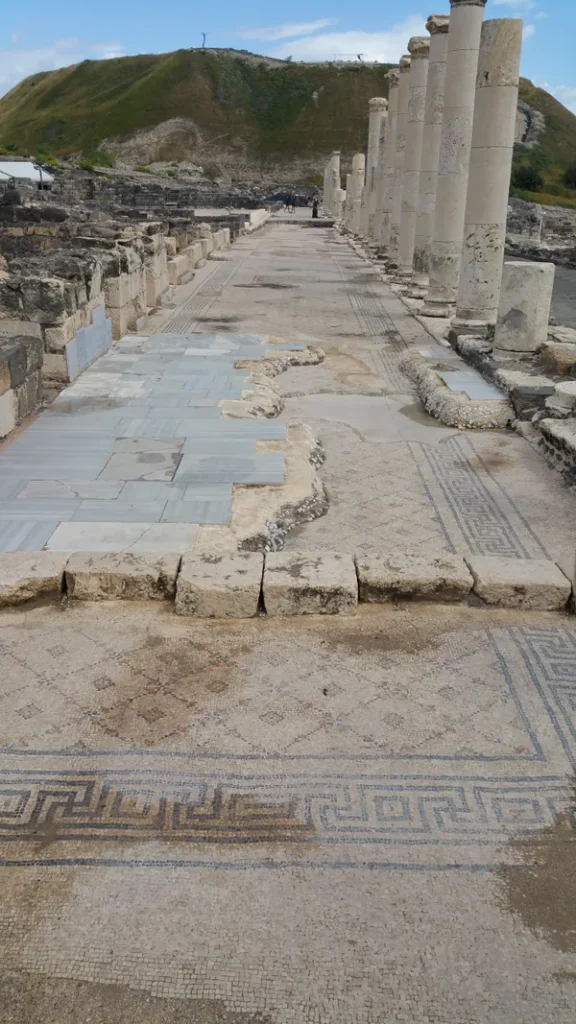
As you continue into the lower valley, the expansive ruins of the Roman and Byzantine city—then known as Scythopolis—unfold before you. You can walk along the wide, colonnaded thoroughfare of Palladius Street, passing complex public bathhouses equipped with underfloor heating systems and elaborate mosaic floors. Throughout the civic center, massive stone pillars remain scattered across the pavement, lying exactly where they toppled during a massive earthquake in 749 CE.
Further along your route, you will find a 7,000-seat Roman theater and an amphitheater originally built for chariot races. These monumental structures highlight the scale of what was once the leading city of the Decapolis. Exploring this site provides a clear view into the ancient world, showing how Israelite origins, Greco-Roman architecture, and a persistent local Jewish community layered together to shape the region.
