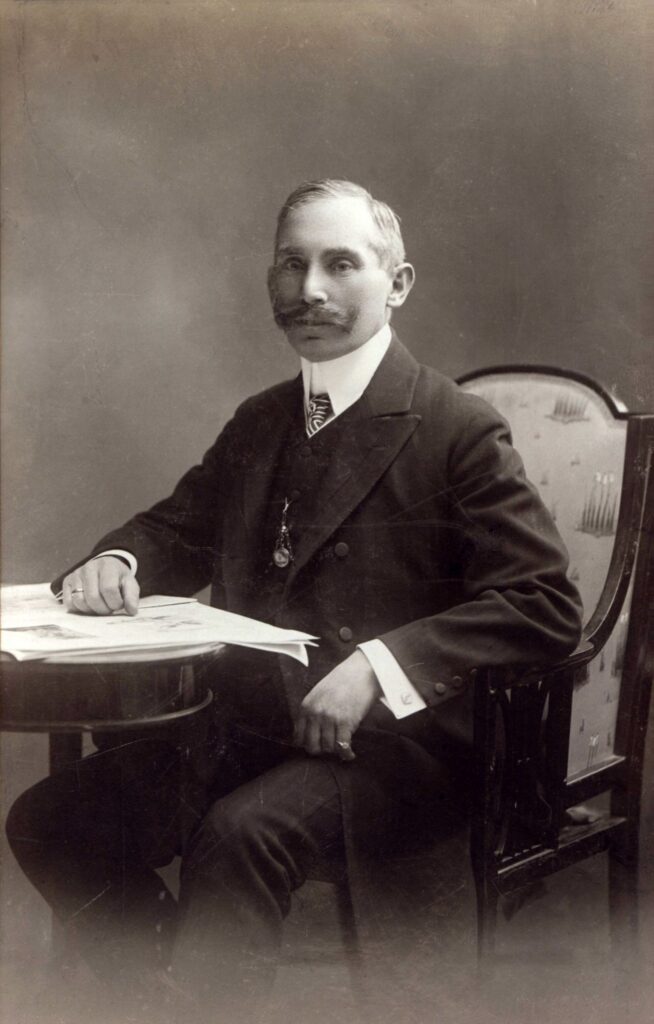
Famous Persons from Szeged’s Jewish Past
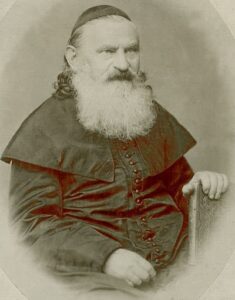
Chief Rabbi Lipót Löw (1811–1875)


Originating from Moravia, was a famous Chief Rabbi of Szeged where he served in his position from 1850 until his death. He was the first representative of the so-called Neolog– (Hungarian moderate reform) movement. Löw was thefirst to introduce Hungarian language use into synagogue service; the first Hungarian sermon is connected to his name. Löw was also an outstanding scholar experienced in religious law, Judaism and archaeology. He had been widely respected until his death; both Emperor Franz Joseph and the Hungarian government often consulted him in religious issues.
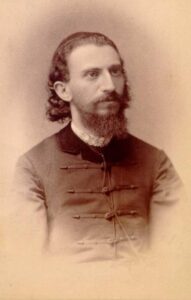
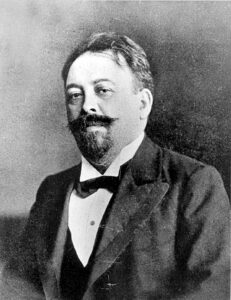
Chief Rabbi Dr. Immánuel Löw
Rabbi Leopold Löw’s son (1854–1944), was an internationally renowned Hungarian Chief Rabbi; represented Jewish Neologs in the Upper Chamber of the Houses of Parliament between 1927 and 1939. He was one of the most excellent scholars of his time: internationally renowned orientalist, writer in cultural-history, scholar in religion and botany. The most outstanding piece of his scholarly work, entitled Die Flora der Juden, describes biblical plants. His book served the basis of the iconological programme of the New Synagogue and its Biblical garden. He remained faithful to Szeged, his hometown, for which he devoted his work.
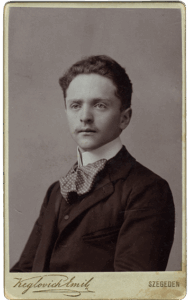
Béla Balázs – internationally renowned film theorist
Béla Balázs (1884–1949) author, symbolist poet, screenwriter and influential film theorist, was born in Szeged on 4 August 1884, as Herbert Bauer. His talent was revealed at an early age. He attended university in Budapest, where he befriended world-renowned composers Béla Bartók and Zoltán Kodály. In 1908, when he earned his Master of Arts degree, his works were published along with those of the most outstanding Hungarian poets of the time, Endre Ady, Mihály Babits and Gyula Juhász, in the A Holnap (Tomorrow) anthology. His main book on film theory, A látható ember (The Visible Man) was published in 1925.
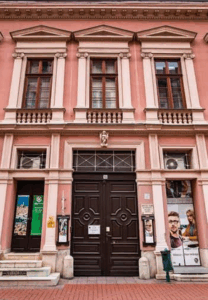
He lived in Berlin from 1926 until 1930, where he worked closely with Bertolt Brecht and became friends with the famous actress Leni Riefenstahl, for whom he wrote scripts. He received the highly prestigious Kossuth Prize in 1948 and passed away the following year. He has a memorial tablet at the Weiss or Vajda House and a bust on Dóm Square in the pantheon, while a projection room for art films bears his name in the local cinema, Belvárosi Mozi. In 1958, a studio in Budapest for young experimental filmmakers was later named in his honour as was a national prize for filmmakers.
Graphic artist Ármin Tardos-Taussig and his family ties to Hollywood
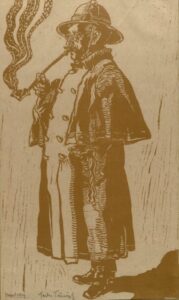
Ármin Tardos-Taussig (1874–1936), graphic designer, was born in 1874 in Timisoara in present-day Romania. He received a degree in engineering at the Budapest University of Technology and Economics then he studied the art of copper engraving under Alfred Wesemann’s supervision in Vienna. His most significant works can be found in the Museum of Fine Arts and the Hungarian National Gallery in Budapest, and in the Móra Ferenc Museum in Szeged. Among these collections, copper engravings, pencil drawings, building designs and lino-cuts bear witness to his talent. He designed the ancient Hebrew carvings and stylized flower ornaments of the New Synagogue. He also created the memorial tablets of the Old Synagogue to commemorate the Jews of Szeged who fell in World War I.
The family had outstanding ties to Hollywood, the city of lights; through Gasparcolor, a colour film system that became well-known to American audiences, which had been invented by their son-in-law, Dr. Béla Gáspár. His invention was licenced by major movie studios.
Lipót Baumhorn – internationally renowned architect
Lipót Baumhorn (1860–1932) designed and (re)built over 42 synagogues and numerous public and residential buildings in Austria-Hungary. The Jewish architect studied at a school established by the famous Viennese architect Ludwig Förster, then he started working in Ödön Lechner and Gyula Pártos’s workshop in Budapest. His time spent there heavily influenced his artistic work (e.g. eastern-style architectural elements).
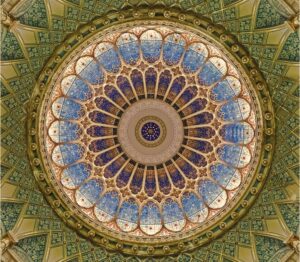
Baumhorn’s clearly recognisable Eclectic style incorporated Romanesque, Gothic, Renaissance, Baroque and Art Nouveau elements, sometimes mixed with Moorish motifs. His synagogue designs followed a strict code: they contained a nearly square prayer room flanked by two or four staircases leading to the women’s gallery. A central octagonal dome, resting on four columns, dominated his creations. Szeged’s New Synagogue is generally regarded as the masterpiece of his career.
Manó Róth – master of the stained glass windows of the New Synagogue
Originally named Emanuel Roth (1868−1935), is the forgotten artist of stained glass art overshadowed by his elder brother’s Miksa Róth’s career. He started an independent business in 1899; however, he often worked with Miksa on large projects (such as the stained glass windows in the Houses of Parliament in Budapest). He maintained a working relationship with the most outstanding figures in Hungarian art and architecture, including Ödön Lechner, Lipót Baumhorn and József Rippl-Rónai.
Despite the common perception, it is Manó who designed the windows in the Szeged Synagogue and the congregation’s headquarters as well (1902). His outstanding glasswork includes the stained glass windows and dome of the building housing the Chamber of Business and Commerce in Győr (1904, decorative windows in the auditorium of the Calvinist High School in Kecskemét (1911), a staircase window depicting Arcadia, based on a design by József Rippl-Rónai in the Ernst Museum in Budapest, now called the Robert Capa Centre for Contemporary Photography (1912), and decorative stained glass windows and 60 compositions (various sizes) made of glass mosaics in the Blue Church in Pozsony (present-day Bratislava, Slovakia) (1913). World War I. Manó is also responsible for the painted glass windows above the foyer to the bath in the famous Gellért Spa in Budapest (1918).
The Herzl family
The Herzl family was one of the most notable Jewish families in Szeged; among their ancestors was Mihály Pollack, founder of the local Jewish congregation. Pollack was involved in commerce and moved from Kisbér to Szeged in 1781, although Jews were only permitted to settle in town as a group from 1786. Mihály Pollack was the first Jewish person in Szeged to buy a house where religious gatherings could be held before the first synagogue was built.
Although Pollack had no sons, his daughters’ children played a significant role in the Jewish community. For instance, Mózes Herzl, a merchant, was one of the first trustees of the Talmud-Torah Chevra (an association dealing exclusively with Hebrew teachings), which was established in 1820. His wife, Perl Grünwald, was a founding member of the first Hungarian Jewish women’s society in Szeged (established in 1835).
János Kotányi (1858−1928)
Became world-famous for his spices. He was born as the sixth child into a family of ten children. He went to Vienna on foot at the age of 14 where he started working as a sales assistant in a grocery store. Later, he opened a paprika mill and a grocery store in Szeged, where he made his debut in 1881 with his locally grown Rose Paprika. Kotányi’s paprika mix, having special aroma, soon conquered Vienna where he also opened business; moreover, he was awarded with the title ’Supplier of the King and the Emperor’. The variety of products has extended with new spices ever since; the flourishing family business is led by his descendants in Vienna.
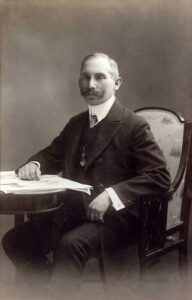
Móricz Pick – builder turned salami industrialist
Móricz Pick (1883–1945) was the child of the founder of the famous salami factory, Márk Pick, and Katalin Weiss, daughter of the Rabbi of Lugoj (in present-day Romania). He grew up in a religious family with his brother Jenő, who became head of the family business, Lajos, who became a sculptor, and Margit, who married Count Artúr Berchtold.
Móricz started his career as an architect. He and his partner, László Tóbiás, took part in the construction of numerous buildings in town. They designed and built the Bokor Palace (9 Bartók Square), close to the New Synagogue, and the Art Nouveau Márer House (109 Lajos Tisza Blvd). The company built the grand Art Nouveau Ungár–Mayer Palace at 16 Kárász Street as well.
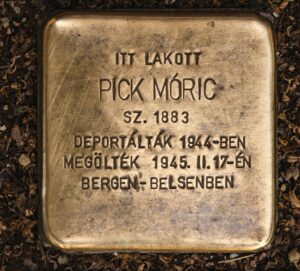
Móricz joined the family salami business in 1922; he ran the factory in Erlau, near Vienna, which functioned with well-trained workers from his hometown and technologies used in the Szeged plant. Móricz left the company due to family disputes in 1934 and spent the rest of his life at 12 Gutenberg Street in his late father’s house, where production of the eventual world-renowned winter salami had once been launched. Móricz Pick lived in this house until 1944; he was deported from here to the Bergen-Belsen concentration camp, where he was killed the following year. His memory is preserved by a stolperstein laid before the entrance to the building (which now functions as a hotel).
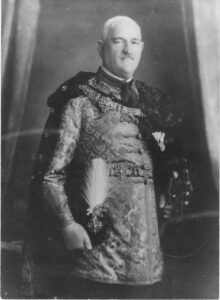
Bernát Back – the first president of the Szeged Rotary Club
Bernát Back de Bégavár (1871–1953) represented Szeged in the Upper Chamber of the Hungarian Parliament. He was also a state counsellor, the first president of the Szeged Rotary Club and the most significant patron of the arts in the city.
He was among the most significant contributors to the building of the New Synagogue of Szeged. Later, he made a large donation to the building of the Cathedral in Szeged; he also donated to the orphans and handicapped of World War I. In 1898, he married Lilly, the daughter of Nándor Eisenstädter, one of Szeged’s wealthiest individuals. In 1906, he and his children converted to Catholicism.
Owning steam mills in Szeged, Győr and Nitra (in present-day Slovakia), the Back family was in the forefront of innovation and technological achievements in the provincial milling industry. Back was also involved in banking. He was president of the Szeged–Csongrád Savings Bank between 1930 and 1942.
With his profound knowledge of European culture, he managed to collect a wealth of paintings and thus opened a gallery in his own home.
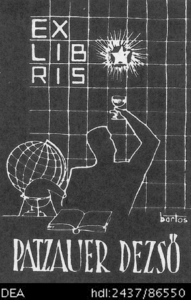
Dezső Patzauer, the father of Szeged’s Anna Fountain
Dezső Patzauer (1899–1990) was a grandson of Miksa Patzauer, a Jewish spirits dealer. He fought in World War I, and then, after the war, he studied bookbinding and worked in Vienna. Finally, he became manager of the Szeged office of the Fővárosi Serfőzde Rt. brewery.
In 1936, he had the water that sprang forth at the crossroads of Kossuth Lajos Av and Tisza Lajos Blvd classified as mineral water (beneficial for musculoskeletal diseases and stomach problems), which he started carbonating, bottling and distributing in 1938. Patzauer received a 25-year licence to exploit the city’s water resources, which included the construction of a drinking hall. To operate the hall, Patzauer founded a thermal and mineral water company. The firm received a permit to transfer the water to its official seat at 9 Kölcsey Street – for carbonation and bottling – through a pipeline that ran 80 cm under Fekete Sas Street. Patzauer named the thermal water source after his daughter, Anna creating a city legend. He left Hungary with his family in 1948 and lived in Toronto until his death (30 December 1990).
Photographer Manci Bäck (1891−1989)
Photographer, studied photography in Vienna then worked in Szeged; her studio/apartment was located in the Reök Palace. She not only took photographs for business purposes; her pictures of peculiar style and perspective reached artistic status. Her topics included female nudes and distinct-style portraits. At the request of the City Council, she also depicted the Palánk neighbourhood before its houses were demolished. Her photos served the need of city audience for over three decades. The famous Hungarian writer, Gyula Juhász called her ’the poet of portrait’.
First trained female librarian Ágota Fischhof (1895−1976)
One of the first female librarians in the country and the first trained librarian in the city. She studied in Berlin on the recommendation of the famous museum director and writer Ferenc Móra. Her exceptional beauty and education inspired several artists visiting Szeged. Béla Balázs and Ferenc Móra based a fictional character on her persona. Poet Gyula Juhász dedicated a poem for her entitled Ex libris. The world-famous artist László Moholy-Nagy portrayed her in the picture known as Tahitian Madonna.
Writer Éva Janikovszky (b. Éva Kucses, 1926−2003)
Szeged-born writer and chief editor, awarded with the highly prestigious Kossuth- and Attila József Prizes. She wrote 28 books, illustrated with László Réber’s emblematic drawings, which were translated into 35 languages. Several of her books were adapted to television; one of the most famous adaptations was the feature film Égigérő fű based on her novel Málnaszörp és szalmaszál for which the highly popular Hungarian rock band LGT composed music. Her topics elaborate on the child-adult relationship, on everyday situations and conflicts with cheerfulness, humour and joy.
Photographer Judit Kárász (1912−1977)
A pioneer artist in the field of sociophotography. Kárász learnt the art of photography in Paris then at the Bauhaus School of Dessau. She had roamed the surrounding villages and farms with her camera as a member of the Szeged Youth Art College; her photographic studies were the first about her hometown and village life in the countryside. Her photographs were exhibited in the Kárász Street along with György Budai’s garphics in 1933. Kárász worked in the photo laboratory of the DEPHOT photo agency in Berlin, and then she became a freelancer first in Berlin, then in Bad Harzburg and Köln in the early 1930s. She had left the country for Denmark in 1935, and only returned to live and work as a museum photographer in Budapest in 1949.